Baxter Healthcare
PartnerStrategic partnership powering Elite Surgical's innovative bone graft solutions
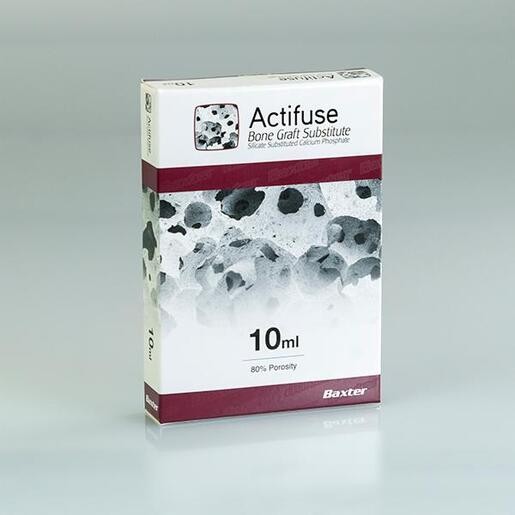
The core ACTIFUSE material: an osteoconductive scaffold your body replaces with bone during healing. FDA cleared for gaps and voids of the skeletal system, extremities, pelvis and spine, including posterolateral spinal fusion with appropriate stabilizing hardware. Not for load-bearing use.
Sizing guidance for the OR: most single-level posterolateral fusions run about 10 cc total. Measure the defect and open only what you need; sizes stack, so a 5 mL plus a 10 mL covers a 15 cc void without waste. Full item list, images and Instructions for Use are on the Baxter catalog page linked below. For same-day delivery or an in-case consult, call Elite Surgical.
Your patient's bone graft substitute isn't integrating well. The fusion rate is lower than expected. You're seeing gaps or poor healing on follow-up imaging.
Poor integration often comes from low porosity or inadequate bioactivity in the graft material. Switch to a silicate-substituted calcium phosphate with 80%+ porosity like ACTIFUSE or ALTAPORE. The enhanced porosity allows better bone ingrowth and vascularization.
You're debating autograft versus synthetic bone graft substitutes for fusion cases. Autograft works but adds OR time and donor site pain. You want to know if synthetics are as effective.
Modern synthetic bone graft substitutes like ACTIFUSE and ALTAPORE show fusion rates comparable to autograft without donor site morbidity. Synthetics eliminate harvest time and reduce patient pain. Consider synthetic for single-level fusions, combine with autograft for complex cases.
You're choosing between ACTIFUSE and ALTAPORE for your fusion cases. Both are silicate-substituted calcium phosphate. You want to know which gives better outcomes.
ACTIFUSE has 80% porosity and proven clinical results. ALTAPORE has 86.3% fusion rates with enhanced porosity design. ALTAPORE offers slightly higher porosity for better bone ingrowth. Consider case complexity and anatomical location when choosing.
You're deciding between synthetic bone graft substitute and allograft for fusion cases. Allograft is familiar but you're concerned about disease transmission and processing. You want to know when to use each.
Use synthetic bone graft substitutes like ACTIFUSE when you want consistent quality without disease transmission risk. Allograft works for structural support in large defects. Synthetics are better for biological fusion enhancement in routine cases.
Your patient is asking when they'll see fusion on X-rays. You're using synthetic bone graft substitute. They want to know the timeline for bone healing and when they can return to activity.
Bone graft substitute integration typically shows on imaging at 6-12 weeks. Solid fusion usually takes 3-6 months depending on patient factors and location. ACTIFUSE and ALTAPORE are designed to remodel into natural bone within 6-12 months of implantation.
You have a patient who needs revision spine surgery. They had synthetic bone graft substitute in the first surgery. You're not sure if it's safe to operate through previous graft material.
Synthetic bone graft substitutes like ACTIFUSE and ALTAPORE are safe for revision surgery. They integrate into natural bone and don't create scar tissue like some materials. Get current imaging to assess integration before planning your approach.
Strategic partnership powering Elite Surgical's innovative bone graft solutions